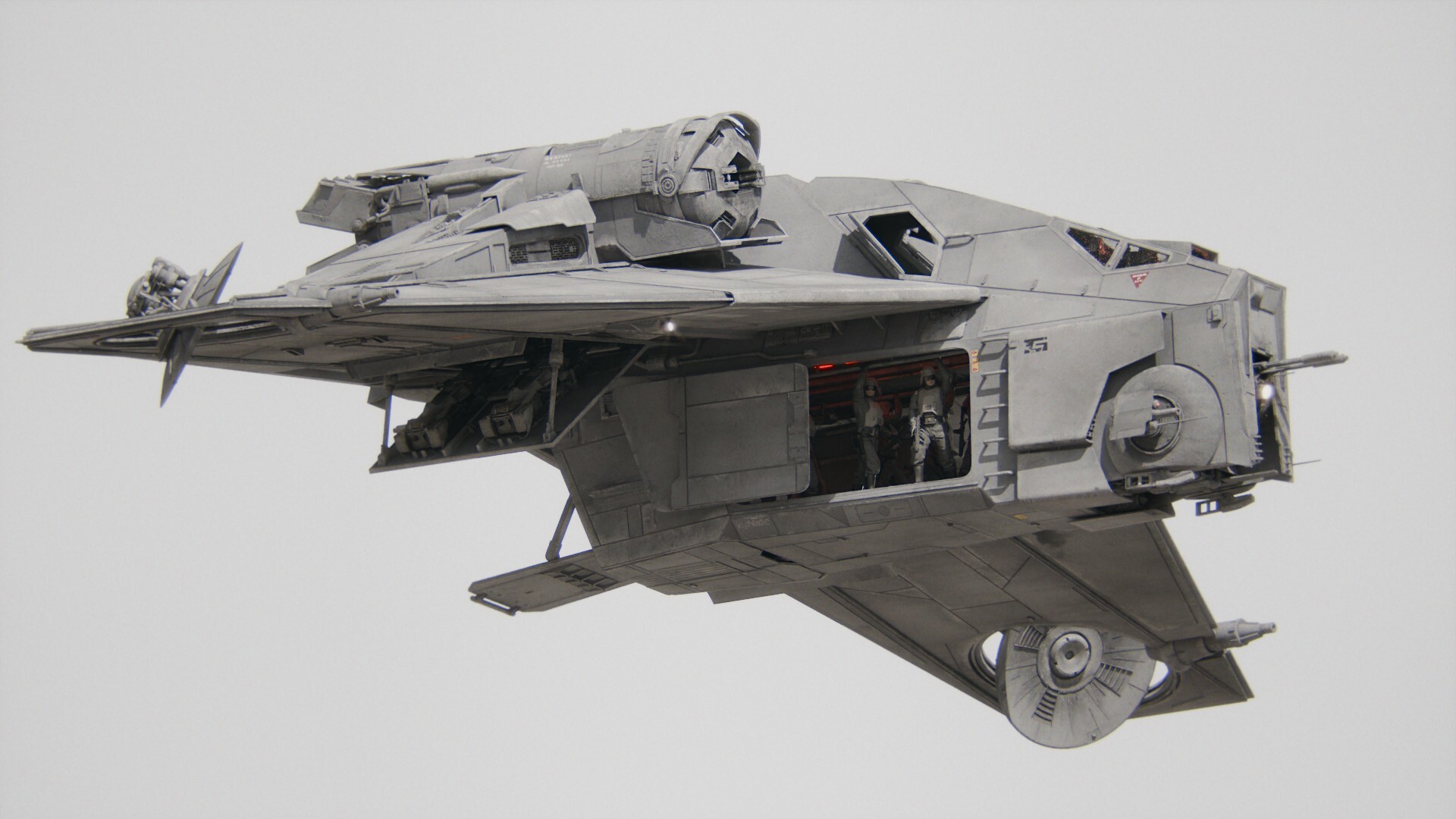
Mandalore's Fist by GrandAdmiralDredd
Type
Airspeeder
Faction
Make & Model
MandalMotors LA-AG
Characteristics
3
4
0
-1
4
| Threshold | 25 |
| Current | 0 |
| Threshold | 20 |
| Current | 0 |
Defense
1
0
Fore
Aft
1
0
0
0
Port
0
0
Starboard
Hyperdrive
Primary: None
Crew
One pilot, one co-pilot/gunner, and one medical Droid (deactivated in storage)
Passengers
40 combatants in full combat gear
Sensor Range
Medium
Consumables
2 weeks
Hard Points
3
Encumbrance
40
Price
100,000 [R]
Rarity
5
Weapons
| Variable Munition Launchers (air-to-air and air-to-ground) |
Firing ArcForward |
RangeMedium |
| Blast 4, Guided 3, Limited Ammo 10, Linked 1, (specialty munitions: Guided 4, Pierce 3, & viscious 3) |
Damage1-7 |
Critical3 |
| Chin-mounted twin heavy blaster cannon |
Firing ArcForward |
RangeShort |
| Linked 1 |
Damage5 |
Critical4 |
| (2x)Cheek-Mounted light blaster cannons |
Firing ArcForward |
RangeShort |
| Linked 1 |
Damage4 |
Critical4 |
| Aft-mounted light laser cannon |
Firing ArcAft |
RangeShort |
Damage5 |
Critical3 |
|
| (2x) Wing Mounted Composite Beam lasers |
Firing ArcAll |
RangeShort |
| Breach 3, Slow-Firing 1, Vicious 4 |
Damage7 |
Critical3 |
Special Features
==Maximum altitude 600 Km
Cargo
==Carries 4 speeder bikes
Notes
As the empire took control, the edict was given that every symbol of the republic had to be retired or redesigned for the new era. This particularly included prominent republic military vehicles, such as the so-called "republic Gunship", which despite the massive costs in scrapping them and commissioning new vehicles it was considered an acceptable loss in the greater goal of projecting the image of an all powerful Empire that inherited nothing from the old corrupt order. Like the rest of the Empires front-line ground attack vehicles the Imperial successor to the republic Gunship would be directly by Kuat Drive yards which, somewhat controversially, restyled the vehicle to have a design and many components in common with its AT Line of walkers. Thus, the LA-AG was born, the Low Altitude Assault Gunship.
Kuat Drive yards operated under the assumption of utter Imperial Air Supremacy in all possible use cases, so these new gunships no longer needed to be as nimble as their republic predecessors and were thus designed with robust armor that was uncharacteristically heavy for an areal vehicle. Kuat argued that these gunships would be penetrating and subduing deeply entrenched insurgent forces, not engaging structured military forces with proper air support. So air defense systems were largely ignored in favor of heavier underside armor and heavier ground targeting weaponry derived from Kuat's AT line Walkers.
That being said, the LA-AG wasn't particularly helpless in aerial combat and could launch air-to-air weapons from launcher modules developed in close cooperation with Sienar Fleet Systems. This collaboration simplified supply logistics by ensuring that all Imperial flying vehicles, regardless of manufacturer, were compatible with the same weaponry and the self-contained nature of the modules meant that even conscripted local ground crews unfamiliar with Imperial ordinance could effectively arm Imperial vehicles.
Additional aerial defenses on the gunship included a turreted rear laser cannon to fend off pursuit. Despite this feature this gunship was considered somewhat easily overpowered from behind and from above, but that was only in the fleetingly unlikely chance that enemies of the Empire would have sufficient command of the airspace to do so. The LA-AG was also equipped with two wingtip composite beam laser dishes. While Highly destructive and a potent source of psychological warfare these weapons were not without their problems. The composite beam dishes of the Republics gunship had been mounted in sealed spherical housings, but to maximize the power output in the same amount of space the Imperial version would significantly scale up the emitter dishes at the cost of the protective housing. This exposed the relatively delicate components to undo wear, coupled with finicky mechanical articulation, the composite beam laser were prone to failure and were consequently used somewhat sparingly.
The original Low Altitude Assault Transport had been an indispensable staple of the republics combat strategy during the clone wars and Kuat had hoped to sell a high volume of these new gunships to the Empire. However, the Empire consistently maintained that strategies involving the tactical insertion and extraction of troops were only employed from a position of weakness and were ultimately unfitting for displays of Imperial power. The idea was to stop rebellion from starting in the first place through raw intimidation, not to engage with them in protracted combat on their own terms. This Combat Philosophy meant that relatively few of these new gunships would see service and even fewer would see front line combat as most were deployed in second or even third waves of attack or entirely after the engagement to mop up and perform search and rescue operations.
The continued manufacturing of these underutilized craft eventually became too much for the bean counters of Kuat to justify, so the entire manufacturing line, all the parts and tooling, were sold off to the most expedient purchaser. In this way, MandalMotors was able to acquire a perfectly functional design and the supplies necessary to build them, as well as saving them significant enough costs to allow them to further iterate on the design. They were thus able to go so far as to solve a number of the issues that otherwise made the design less attractive to the mid- to high-end mercenary companies. the development team at M.M. were able to solve the ponderous nature of the air-speeder's avionics and resealed the delicate mechanical parts of the composite beam laser. The design teams most recent iteration makes use of a in-house developed Variable Munition Launcher, compatible with most types and styles of heavy ordinance; though it was developed especially to fire swarms of Kinetic Kill Vehicles loving called "screaming jai'galaar".
The final lasting issue that the company was able to solve with some of their third generation models relates to the availability of part and modifications to the vehicle. With the development line still reliant on numerous parts exclusive to other manufacturers, such as Kuat and Seinar, M.M. made the decision to modify the internal architecture of the design to allow it to more easily incorporate aftermarket modifications and parts from other manufacturers from across the galaxy. Recognizing the success of the aftermarket renaissance that the newer generations of Corellian Engineering Corporation vessels had been experiencing, they pivoted away from exclusivity of parts compatibility as much as possible. This allowed them to make use of more of their own internal production, as well as pull from other suppliers to fulfill orders as repeated rounds of sabotage at both Kuat and Seinar made part for third party manufacturers more and more scarce.
Kuat Drive yards operated under the assumption of utter Imperial Air Supremacy in all possible use cases, so these new gunships no longer needed to be as nimble as their republic predecessors and were thus designed with robust armor that was uncharacteristically heavy for an areal vehicle. Kuat argued that these gunships would be penetrating and subduing deeply entrenched insurgent forces, not engaging structured military forces with proper air support. So air defense systems were largely ignored in favor of heavier underside armor and heavier ground targeting weaponry derived from Kuat's AT line Walkers.
That being said, the LA-AG wasn't particularly helpless in aerial combat and could launch air-to-air weapons from launcher modules developed in close cooperation with Sienar Fleet Systems. This collaboration simplified supply logistics by ensuring that all Imperial flying vehicles, regardless of manufacturer, were compatible with the same weaponry and the self-contained nature of the modules meant that even conscripted local ground crews unfamiliar with Imperial ordinance could effectively arm Imperial vehicles.
Additional aerial defenses on the gunship included a turreted rear laser cannon to fend off pursuit. Despite this feature this gunship was considered somewhat easily overpowered from behind and from above, but that was only in the fleetingly unlikely chance that enemies of the Empire would have sufficient command of the airspace to do so. The LA-AG was also equipped with two wingtip composite beam laser dishes. While Highly destructive and a potent source of psychological warfare these weapons were not without their problems. The composite beam dishes of the Republics gunship had been mounted in sealed spherical housings, but to maximize the power output in the same amount of space the Imperial version would significantly scale up the emitter dishes at the cost of the protective housing. This exposed the relatively delicate components to undo wear, coupled with finicky mechanical articulation, the composite beam laser were prone to failure and were consequently used somewhat sparingly.
The original Low Altitude Assault Transport had been an indispensable staple of the republics combat strategy during the clone wars and Kuat had hoped to sell a high volume of these new gunships to the Empire. However, the Empire consistently maintained that strategies involving the tactical insertion and extraction of troops were only employed from a position of weakness and were ultimately unfitting for displays of Imperial power. The idea was to stop rebellion from starting in the first place through raw intimidation, not to engage with them in protracted combat on their own terms. This Combat Philosophy meant that relatively few of these new gunships would see service and even fewer would see front line combat as most were deployed in second or even third waves of attack or entirely after the engagement to mop up and perform search and rescue operations.
The continued manufacturing of these underutilized craft eventually became too much for the bean counters of Kuat to justify, so the entire manufacturing line, all the parts and tooling, were sold off to the most expedient purchaser. In this way, MandalMotors was able to acquire a perfectly functional design and the supplies necessary to build them, as well as saving them significant enough costs to allow them to further iterate on the design. They were thus able to go so far as to solve a number of the issues that otherwise made the design less attractive to the mid- to high-end mercenary companies. the development team at M.M. were able to solve the ponderous nature of the air-speeder's avionics and resealed the delicate mechanical parts of the composite beam laser. The design teams most recent iteration makes use of a in-house developed Variable Munition Launcher, compatible with most types and styles of heavy ordinance; though it was developed especially to fire swarms of Kinetic Kill Vehicles loving called "screaming jai'galaar".
The final lasting issue that the company was able to solve with some of their third generation models relates to the availability of part and modifications to the vehicle. With the development line still reliant on numerous parts exclusive to other manufacturers, such as Kuat and Seinar, M.M. made the decision to modify the internal architecture of the design to allow it to more easily incorporate aftermarket modifications and parts from other manufacturers from across the galaxy. Recognizing the success of the aftermarket renaissance that the newer generations of Corellian Engineering Corporation vessels had been experiencing, they pivoted away from exclusivity of parts compatibility as much as possible. This allowed them to make use of more of their own internal production, as well as pull from other suppliers to fulfill orders as repeated rounds of sabotage at both Kuat and Seinar made part for third party manufacturers more and more scarce.